Saturday, October 22, 2016
Rautavaara: A Basic Discography
Einojuhanni Rautavaara (1928-2016) was not only the most significant Finnish composer after Sibelius, but very probably among the finest of all later-twentieth century masters regardless of nationality. Rautavaara is undoubtedly the greatest composer most people have never heard of, and that's certainly a shame, for his music is fascinating, engagingly multi-faceted, often beautiful, deeply rewarding on many levels, and virtually always entertaining.
Stylistically, through the course of his long career, Rautavaara was all over the map, from the arid, pointillist soundscapes of modish 50s-era serialism, to the highly accessible, lushly consonant tone-paintings of twenty-first-century neo-romanticism, and, seemingly, everywhere in between. Probably his best-known work, the Cantus Arcticus (Concerto for Birds and Orchestra), Op. 61 falls squarely in this latter category. So much more than a mere experimental piece in which tape of diverse bird songs and calls are accompanied by an orchestra, this is a powerful, haunting work of art, in which the composer achieves a kind of mystical polyphonic synergy between the sounds of nature and the instruments of the orchestra, with moments so poignant and achingly beautiful as to bring the listener close to tears.
Like his contemporaries Pärt, Tavener, Penderecki, and--to some extent--Górecki, Rautavaara often explored spiritual and mystical themes, as in the early neo-classical Requiem in Our Time and the avant garde Playgrounds for Angels, both for brass ensemble, the relatively late Symphony #7 'Angel of Light' or his a cappella choral magnum opus Vigilate. He seemed to draw inspiration from everything around him, whether seen or unseen, but his metaphysical musings are neither treacly nor insincere. One never gets the sense of being manipulated, proselytized or beaten over the head with the flail of absolute certainty, or bored to tears (as so often with Tavener) by an overly opportunistic or downright mercenary mysticism or (as occasionally with Penderecki) stale dogmatic digression.
To those seeking a relatively painless way into the world of Rautavaara, I highly recommend the 1999 Naxos release from Hanu Lintu and the Scottish National Orchestra, which includes Cantus Arcticus in a lovely reading with just the right balance of understated power, awe and exultation, as well as the Symphony #3 and the Piano Concerto #1. Well-played and superbly recorded, this album makes a near-perfect introduction to the composer's oeuvre. Those who find their appetites sufficiently whetted may next want to explore the series of 4-disc boxed sets compiled by the Finnish Ondine label in 2009: 'The 8 Symphonies' (Ondine ODE 1145-2Q), and the twelve (of the composer's fourteen) Concertos, including 'Cantus Arcticus' (Ondine ODE 1156-2Q), as well as a generous sampling of choral works (Ondine ODE 1186-2Q (2012)). Ondine has done yeoman service in recording so much of the composer's work over the years, and readers will note that all but one of the items in the following discography (based on my own collection) originate from that prestigious label.
Naxos 8.554147 (1999)
Rautavaara: Cantus Arcticus Op. 61 (Concerto for Birds and Orchestra)
Piano Concerto #1 Op. 45
Symphony #3 Op. 20
Laura Mikkola (piano)
Hannu Lintu/Royal Scottish National Orchestra
Ondine ODE 1186-2Q (4-disc box set) (2012 compilation)
Rautavaara: Choral Works
Ondine ODE 1156-2Q (4-disc box set) (2009 compilation)
Rautavaara: 12 Concertos
Ondine ODE 1145-2Q (4-disc box set) (2009 compilation)
Rautavaara: The 8 Symphonies
Ondine 1000-2 (2-disc set) (2003)
Rautavaara: Alexis Kivi (opera in three acts)
Jorma Hynenin et al.
Markus Lehtinen/Jyväskylä Sinfonia
Ondine 750-2 (2-disc set) (1995)
Rautavaara: Vincent (opera in three acts)
Jorma Hynenin et al.
Fuat Manchurov/Finnish National Opera Orchestra and Chorus
Ondine 1125-2D (2008)
Rautavaara: Complete Works for Male Choir
Matti Hyökki/YL Male Voice Choir
Pasi Hyökki/Talla Vocal Ensemble
Ondine 1085-2 (2006)
Rautavaara: Song of My Heart (Orchestral Songs)
Gabriel Suovanen
Lief Segerstam/Helsinki Philharmonic Orchestra
Ondine 1149-2 (2010)
Rautavaara: Before the Icons
A Tapestry of Life
Lief Segerstam/Helsinki Philharmonic Orchestra
Ondine 957-2 (2000)
Rautavaara: A Requiem in Our Time (Complete Works for Brass)
Hannu Lintu/Finnish Brass Symphony
Ondine 909-2 (1998)
Rautavaara: Quintet for Strings 'Unknown Heavens'
String Quartet #1
String Quartet #2 Op. 12
Jean Sibelius String Quartet et al.
Monday, October 3, 2016
RIP Sir Neville Marriner (1924-2016): 25 Great Recordings
The world of classical music has lost one of its giants. Sir Neville Marriner, who passed away this month at the age of 92 was certainly one of the most prolific recording artists of all time with more than 600 recordings to his credit. Well over 400 of those were made with the Academy of St. Martin-in-the-Fields (ASMF) the ensemble he founded in 1959, and first recorded with in 1962 for the L’Oiseau-Lyre label. The ASMF (which never recorded in the London church for which it is named) would also subsequently make many notable albums for the Argo label beginning in 1963-64 and into the early 1980s, as well as for Philips from about 1970, with Marriner appearing as conductor, leader, or ensemble member. As the founding music director of the Los Angeles Chamber Orchestra (LACO) in 1969, Marriner also forged a fruitful association with EMI in the mid to late 1970s.
In my 2014 review of Decca's 38-disc box set, Neville Marriner: The Argo Years, I indulged a bit of musical nostalgia:
You could hardly get through an hour of FM classical programming in the ‘70s without hearing something from Neville Marriner and the Academy of St. Martin-in-the-Fields. The opening Sinfonia movement of the ensemble’s ravishingly beautiful 1968 Argo recording of Stravinsky’s Pulcinella Suite was the theme music for the popular Matinée program on public radio, and every classical DJ from New York to San Francisco seemed to be spending an inordinate amount of air time waxing pompously authoritative (mostly quoting liner notes) about the Rossini string sonatas, the Boyce symphonies, the Telemann Don Quichotte Suite, or the Corelli Concerti Grossi Opus 6, or filling up the last five minutes of their shows with Henry Cowell’s lovely Hymn and Fuging Tune Nr. 10 or Paul Creston’s rollickingly sardonic masterpiece, A Rumor, both from the 1976 Argo album of twentieth-century American music. Indeed, by the latter half of the decade Marriner and the Academy had become such a staple of classical radio that a cartoon appeared in Stereo Review magazine: a man sits in his living room listening to the radio with his pet parrot. The announcer begins “That was the Academy of St. Martin-in-the-Fields . . .” to which the parrot squawks “Neville Marriner conducting!”
I didn't mention in that review that I'd gotten to see and hear Marriner conducting live once back in the early 1980s. It was his first stop on a tour with The Minnesota Orchestra, playing Sibelius and Haydn at the original Hancher Auditorium in Iowa City. Well over six feet tall in tails, Marriner cut an impressive figure on stage, sweeping over to the podium with a kind of brusque grace reminiscent of a cheetah or a tiger. My immediate impression was that of intense focus and precision, a tightly coiled kinetic energy waiting to be released. Would that the music-making that night had been equal to my anticipation: in truth, all I can recall about Marriner's reading of the Sibelius Fifth (one of my very-favorite works of the standard repertory) is that it was unbelievably dull, offering little sense that the conductor understood or even cared about the spatial aspects of the music. Granted, Hancher was never one of the world's great concert spaces acoustically speaking; but the sort of dry, flat sound that drifted out towards the seats was disillusioning to say the least. On the other hand, Marriner's Haydn (one of the London symphonies) positively sparkled that evening.
This got my young self to thinking about what makes the difference between an effective live performance and a successful recorded one. Where we might automatically assume that a live reading is more spontaneous and energetic than something done in the studio, this is not necessarily the case. The demands of the studio impose a set of limitations, within which, a thoughtful artist can thrive. And Marriner understood the recording process like few others before or since:
(On record) one always got the impression of an unstinting perfectionist with acute attention to detail and unfailing musical instincts. Where the notorious fastidiousness of many of the older generation of “tyrant” conductors manifested itself all-too-often in heavy, stiff or stultified playing, Marriner’s interpretations are invariably vibrant, animated with a lyrical buoyancy and lightness of texture, transparent ensemble revealing rich inner detail, agility of articulation, subtlety of ornamentation, shimmering strings, colorful, beautifully blended winds, and overall, an infectious, dazzling sense of élan. These qualities are equally evident in Marriner’s performances of twentieth-century masterpieces by Stravinsky, Prokofiev and Bartok as in his readings of Baroque works by Corelli, Vivaldi, Handel, Bach, and Boyce, or Romantic music by Bizet and Wagner.
Here, by way of tribute, are twenty-five of my favorite recordings by Neville Marriner.
1
LP: Argo ZRG 845 (1976)
Barber: Adagio for Strings
Ives: Symphony #3
Copland: Quiet City
Cowell: Hymn and Fuguing Tune No. 10
Creston: A Rumor
ASMF
2
LP: Argo ZRG 657 (1970)
Bartok: Music for Strings Percussion and Celeste
Divertimento for Strings
ASMF
3
LP: Philips 6500 113 (1971)
Beethoven Symphony # 1 in C Major Op. 21
Symphony #2 in D Major Op. 36
ASMF
4
LP: Argo ZRG 719 (1973)
Bizet: Symphony in C
Prokofiev: Symphony #1 in D Op. 25 'Classical'
ASMF
5
LP: Philips 9500 566 (1979)
Bizet: Carmen Suites
L'Arlésienne Suites
London Symphony
6
LP: Argo ZRG 573 (1968)
Elgar: Music for Strings
Serenade Op. 20; Introduction and Allegro etc.
ASMF
7
LP: Philips 9500 424 (1987)
Elgar: 'Enigma' Variations Op. 36
Pomp and Circumstance Marches (3)
Concertgebouw Orchestra
8
Argo ZRDL 1003 (digital LP); 410-552-2 (CD) (1982)
Fauré Pelleas et Melisande Suite Op. 80;
Pavane Op. 50;
Masques et Bergamasques Suite Op. 112
ASMF
9
LP: Philips 9500 519 (1978)
Haydn: Symphony #82 in C Major 'The Bear'
Symphony #83 in g minor 'The Hen'
ASMF
10
LP: Philips 9500 425 (1978)
Holst: The Planets Op. 32
Concertgebouw Orchestra
11
LP: Argo ZRG 605 (1970)
Mendelssohn: Concerto in E for two pianos and orchestra
Concerto in a minor for piano and strings
Brenda Lucas/John Ogden/ASMF
12
LP: Philips 6500 325 (1972)
(also Philips 6707 020 (4 LP box set) (1972) Complete Wind Concertos)
Mozart: The Four Horn Concertos
Alan Civil
ASMF
13
LP: Philips 6500 380 (1972)
(also Philips 6707 020 (4 LP box set) (1972) Complete Wind Concertos)
Mozart: Concerto for Flute and Harp in C major K 299
Claude Monteux (flute)/Osian Ellis (harp)
ASMF
14
CD: Philips 432-087-2 (1991)
Mozart: Requiem K 626
Sylvia McNair/Carolyn Watkinson
Francisco Araiza/Robert Lloyd
ASMF
15
LP: EMI (His Master's Voice) ASD 3188 (1976)
Resphigi: Ancient Airs and Dances (Suites 1-3)
LACO
16
LP: EMI (His Master's Voice) ASD 3327 (1978)
Resphigi: The Birds
Three Boticelli Pictures
ASMF
17
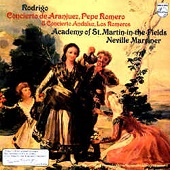
LP: Philips 9500 563 (1979)
Rodrigo: Concierto de Aranjuez
Concierto Andaluz
Pepe Romero/ASMF
18
Hänssler Classics CD 983 53 (2000)
Sibelius: The Tempest Incidental Music Op. 109
Violin Concerto in d minor Op. 47
Dmitri Sitkovestsky/ASMF
19
Argo ZRG 604 (1969)
R. Strauss: Metamorphosen for twenty-three solo strings
Wagner: Siegfried-Idyll
Baermann: Adagio for Clarinet and Strings (formerly attributed to Wagner)
ASMF
20
Argo ZRG 575 (1968)
Stravinsky: Pulcinella Suite;
Apollon Musigate ballet
ASMF
21
LP: EMI (Angel)
Stravinksy: Danses concertantes
Dumbarton Oaks Concerto;
Concerto in D for strings
LACO
22
Argo ZRG 680 (1975)
Tippett: Music for String Orchestra
ASMF
23
Argo ZRG 696 (1977)
Vaughan Williams: Fantasia on a Theme of Tallis
The Lark Ascending
Fantasia on Greensleeves
Five Variants of Dives and Lazarus
ASMF
24
LP: Argo ZRG 654 (1970)
Vivaldi: The Four Seasons Op. 8
Alan Loveday/ASMF
25
CD: Chandos CHAN 8841 (1991)
Walton: Richard III: Shakespeare Scenario (arr. C. Palmer)
MacBeth (suite from the film)
Major Barbara (suite from the film)
Sir John Gielgud (speaker)
ASMF
Thursday, September 8, 2016
Randal Thompson's "Requiem"
Naxos 8.559789 (2016)
Randal Thompson: Requiem (1958)
The Philadelphia Singers
David Hayes
Beautifully sung, this first-ever complete recording of one of Randal Thompson's most personal musical statements will be of great interest to aficionados of 20th-century American choral music and the colorful tradition of the extra-liturgical Requiem from Brahms onward.
Composed in 1958 in response to a commission from the University of California at Berkeley, Thompson's Requiem is structured as a dialogue between two choral groups; a chorus of mourners and a chorus of the faithful. Texts are drawn from a surprisingly diverse selection of Biblical sources ranging from the books of Job, Lamentations and the Psalms to the prophet Habakkuk and the first epistle to the Corinthians. (The regular insert accompanying the disc includes the complete texts--something of a rarity for Naxos.) The music itself is easily accessible, reflecting Thompson's deep interest in Renaissance madrigals combined with the "white frame" American hymn tradition tracing back to Billings and Mason; florid, consonant, and--even for its day--stylistically conservative, though undeniably serving up the occasional moment of drama and exultation.
While not lacking in presence, Naxos' recorded sound is decidedly on the dry side with minimal resonance--one would expect greater clarity of diction as a result, but this is not always the case.
Recommended.
Monday, August 29, 2016
Baroque Splendor: Muffat's Missa in labore requies
Audite 97.539 (SACD) (2016)
Georg Muffat (1653-1704): Missa in labore requies a 24
Heinrich Ignaz Biber (1644-1704): Sonata VI a 5: Sonata VIII a 5
Antonio Bertali (1605-1669): Sonata Sancti Placidi a 14: Sonata a 13
Johann Heinrich Schmelzer (circa 1623-1680): Sonata XII a 7
Cappella Murensis
Les Cornets Noirs
Johannes Strobl
Recorded in the magnificently orotund acoustics of the Abbey Church of Muri in Switzerland, this 2016 performance of Georg Muffat's only surviving sacred work is truly a joy to hear. The German Audite label gives us an uncannily naturalistic super-audio sound that captures the festive verve and antiphonal grandeur of the music without superfluous bombast or technical gimmickry. The Mass--apparently composed for an episcopal coronation coinciding with the celebration of Pentecost--features two vocal and three instrumental choirs, here luxuriously deployed throughout the Muri sanctuary with its four corner galleries high above the main floor. Yet all forces are superbly balanced, lending a sense of fleetness and transparency to the score that has often been missing in recordings of music from this period (most notoriously in some of Paul McCreash's muddy readings of Biber and Schutz for DG Archiv). Soloists, choir, and strings create a delightful synergy in play with the outstanding Les Cornets Noirs--baroque brass has seldom sounded so vibrant or so lithe; the creative use of stops and mutes in sections of the Credo is truly revelatory. The diverse 'sacred sonatas' for strings and brass by Muffat's contemporaries that fill out the disc are equally well-played and highly enjoyable.
The disc comes in a standard SACD jewel case with a 31-page booklet, featuring program notes in German and English, with an extensive--and fascinating--essay about the life and work of the composer--a colleague and rival of Biber at the court of Salzburg from 1678 to 1690--by Ernst Hintermeier, peppered with mouth-watering tidbits of musicological trivia. The manuscript of the Missa Labore in Requies eventually came into the possession of no less a figure than Franz Joseph Haydn, and resided in the musical collection of the Esterhazy family until its "discovery" in 1991 (before which the work had been deemed spurious by the broader scholarly community).
Overall a very handsome and desirable production. If you are a fan of Jordi Saval's exciting readings of Biber and Monteverdi, Strobl's Muffat will definitely be for you.
Monday, May 16, 2016
A Life in Collecting: Thirty Years with the Compact Disc
I collected my first compact disc thirty years ago in 1986. I'd been collecting LPs for twelve years prior to that, having built up a collection of about 1,000 albums on vinyl. The first CD I ever owned was Chandos CHAN 8332 (1984) Mary's Music: Songs and Dances from the Time of Mary Queen of Scots, performed by the Scottish Early Music Consort under Warwick Edwards. I still have it today, and it sounds just as good as it did three decades ago. (Those who claim that CDs somehow 'deteriorate' over time, or are damaged by repeated playing, are clearly misinformed.) In many ways, I have never looked back. My current collection comprises nearly 1700 CD albums (aproximately 3000 discs) and grows a little more each week.
I do recall with some nostalgic fondness the first few years of LP collecting, the youthful thrill of discovery, and the endearing intimacy of the medium. But, if we're being honest, it must be said that LPs--vinyl in general--had a fair number of serious problems related to storage and playback. Not least among these was the utter abysmal production quality of certain American labels in the late 70s and early 80s: buying anything on RCA, Nonesuch, or EMI/Angel was a virtual crap-shoot back then as chances were very good the record would be badly warped or otherwise unplayable. This was one reason I turned heavily towards imported pressings on European affiliate labels--all fine and good when the US dollar was strong and imports fairly cheap in the early 80s (and I certainly did my part to inflate the US trad deficit in those years!) but the party was not to last. CDs were already on the horizon and looking like an increasingly attractive (if not always less expensive) alternative.
I hung on (or held out as it were) for a few years, having invested so much passion, money, and time in my LP collection. But the writing was on the wall. I tried to use the best playback equipment I could afford (a very good Philips turntable for starters), and when the experience was 'on' it was very good indeed. But, more often than not, I would be a nervous wreck, worrying about whether the balance on the turntable was up to snuff, whether my stylus was wearing down the grooves, or whether the records were being stored in the optimal upright position--I spent a fair chunk of money on heavy-cardboard cases--or whether the LP surface was sufficiently clean and static free, given the latest pronouncements in the endless debate about the efficacy of DiscWasher products--I still have my trusty old Zero-Stat gun!--or wondering how some new pop or click had mysteriously appeared on a surface I'd taken pains to assure was pristine . . .
In the end, I spent thousands of dollars, only to discover that I wasn't enjoying the experience very much--that I was effectively being distracted by the medium itself, and these problems were seriously getting in the way of the essential enjoyment of the music.
Not that early CDs didn't have their fair share of issues. Compact discs were touted heavily in the early 80s with some rather extravagant and 'creative' claims made about the nascent medium that, in retrospect, seem almost comical. In its efforts to gain a market foothold, the industry insisted that CDs were 'virtually indestructible' and 'less prone to skipping' (both assertions quickly disproved), along with the still hotly-debated claim that 'CDs sound better than records . . .' This latter notion was belied by far too many early digital releases, which suffered from harsh trebles, raucous basses, and muddy mid-ranges, mastered at extreme levels, either flat-out, wide-open, speaker-blowingly LOUD (the Swedish BIS label even included a warning on its jewel cases!) or maddeningly muted, so soft as to require a furious right-ward twist of the volume knob that seldom made things sound better. (The Chandos label was conspicuously guilty of excess at both ends of the spectrum.)
Probably the best case for the new technology, Sony Japan's 1985 re-issues of the classic Bruno Walter/Columbia SO recordings of Mozart, Brahms, and Bruckner were stunning, retaining the best qualities of the warm, early-60s (pre-transistor) recorded sound, with a thoughtfully expanded dynamic range and improved clarity of detail (notwithstanding a vestigial hint of tape hiss). These early issues are still very much worth seeking out, especially considering the disappointing quality of many of Sony's subsequent re-masterings:
CBS MK 42024: Brahms Double Concerto
CBS MK 42929: Brahms Symphony #1 (1960)
CBS MK 42021: Brahms Symphony #2 (1960)
CBS MK 42022: Brahms Symphony #3 (1960)
CBS MK 42023: Brahms Symphony #4 (1960)
CBS MK 42035: Bruckner Symphony #4 (1961)
CBS M2K 42036: Bruckner Symphony #7; Wagner Siegfried Idyll (1963)
CBS MK 42037: Bruckner Symphony #9 (1960)
CBS MK 42029: Mozart: Eine Kleine Nachtmusik etc. (1961)
CBS MK 42026: Mozart Symphonies #s 35 and 39 (1960, 1963)
CBS MK 42027: Mozart Symphonies #s 36 and 38 (1960, 1963)
CBS MK 42028: Mozart Symphonies #s 40 and 41 (1959, 1960)
From the beginning, it has been my goal to re-collect on CD virtually everything I once owned on LP. This has been relatively easy a lot of the time, much more difficult and expensive for many things, and nigh on to impossible for a few titles from more obscure labels that seem to have vanished into the mists of commercial oblivion, never to be resurrected on CD or any other format--not to mention those performances the major labels stubbornly refuse to pull from their vaults. Nonetheless, I am always thrilled to re-discover an old friend. Some of my most joyous recent finds include the 1993 re-issue of Bernard Kruysen and Noel Lee's 1973 recital of Ravel Mélodies on Valois (V 4700), John Eliot Gardiner's lush rendition of Purcell's music for The Tempest (Erato 2292-45555-2 (1980)), and the 2013 re-issue of Ole Schmidt's 1974 Nielsen cycle (the first complete stereo cycle, originally appearing on the Unicorn label) (Alto ALC 2505).
I am particularly encouraged by the current trend towards retrospective box sets. This not only allows one to collect a great deal of wonderful music at reasonable price, but is, ultimately, the most convenient, least problematic form of packaging for optical media. The jewel case and its myriad variations comes with a whole raft of problems, including inconsistent quality standards, sub-par manufacture, brittle, cheap plastics that can damage disc surfaces, and ill-considered design that takes up too much space on the shelf while affording little protection for the discs. If I have a serious pet peeve, it's broken or cracked 3- or 4-disc jewel cases (difficult and expensive to replace) and media trays that either fail to hold the discs in place, allowing them to rattle around loose inside the case, or are too tight, threatening possible damage to the spindle holes on removal.
Still, all things considered, it's been a good thirty years. In the end, I think, CDs have lasted and will continue to have a place in recorded music because of their ingenious simplicity.
just a small peek at some of my collection!
Tuesday, May 3, 2016
Ravel's 'L'Heure espagnole' and 'L'Enfant et les sortileges': recent recordings
Decca 478 6760 (2015)
Ravel: L'Enfant et les sortileges
Shéhérazade; Alborada del gracioso
Isabel Leonard (L'enfant (soprano))
Susan Graham (Shéhérazade (soprano))
Seiji Ozawa/Saito Kinen Orchestra et al.
Naxos 8.660366 (2015)
Ravel: L'Enfant et les sortileges;
Ma Mère l'Oye (complete ballet)
Hélène Hébrard (L'enfant (soprano))
Leonard Slatkin/Orchestre National de Lyon
Naxos 8.660337 (2016)
Ravel: L'Heure espagnole;
Don Quichotte à Dulcinée
Isabelle Druet (Concepcion (mezzo-soprano))
Luca Lombardo (Torquemada the clockmaker (tenor))
Frédéric Antoun (Gonzalve (tenor))
Marc Barrard (Ramiro (baritone))
Nicolas Courjal (Don Inigo Gomez (bass))
Francois Le Roux (baritone (Don Quichotte))
Leonard Slatkin/Orchestre National de Lyon
Few recordings have captured the lyric whimsy--the sheer magic--of Ravel's L'Enfant et les sortileges
quite so brilliantly as Seiji Ozawa's 2015 release from Decca. The 1925 score, to a libretto by Collette, is here exquisitely detailed, revealing an extraordinary, vibrant range of color and emotion. Leonard Slatkin's 2015 reading for Naxos, while not attaining the same ecstatic heights, is still very fine, and well worth the label's bargain asking price. I was less impressed with Hélène Hébrard's Enfant--perhaps a tad too mature-sounding by comparison with Isobel Leonard's wonderfully characterized performance for Ozawa. The accompanying ensembles are well-matched--at least on paper--but Slatkin's Lyon players feel less involved, and Naxos' recorded sound--superb as it is--does not capture the same level of fine detail within the score.
Slatkin also recorded Ravel's earlier one-act opera buffa L'Heure espagnole (1911) for Naxos in 2016, and this, too, is more than merely serviceable, featuring an excellent cast, consistently well-accompanied, though I think, ultimately, it lacks the 'authority' of the classic recordings by Lorin Maazel (DG (The Originals) 449 649 (1997 re-issue from 1965)) or Ernest Ansermet for Decca. (And one is more than a little perplexed by Francois Le Roux's awful, misbegotten interpretations of the three Don Quichotte songs as filler on the disc. What could the folks at Naxos possibly have been thinking?)
Tuesday, April 26, 2016
Music to Hear! Great Compositions Inspired by the Bard
Sonnet VIII
Music to hear, why hear'st thou music sadly,
Sweets with sweets war not, joy delights in joy;
Why lov'st thou that which thou receiv'st not gladly
Or else receiv'st with pleasure thine annoy?
If the true concord of well-tuned sounds
By Unions married do offend thine ear,
They do but sweetly chide thee who confounds
In singleness the part that thou should'st bear.
Mark how one string, sweet husband to another
Strikes each in each by mutual ordering,
Resembling sire and child and happy mother,
Who, all in one, one pleasing note do sing:
Whose speechless song being many seeming one,
Sings this to thee: thou single wilt prove none.
As the world marks the 400th anniversary of Shakespeare's death on 23 April, 1616, I thought it apropos to highlight a few interesting musical works inspired by the Bard. Of course, Mendelssohn's music for A Midsummer Night's Dream and Tchaikovsky's Romeo and Juliet will be on everyone's list--and there are dozens of fine recordings of each from Sir Thomas Beecham and Andre Previn to Claudio Abbado and Charles Dutoit--but I've opted for a few slightly-more off-the-beaten-track choices, especially things I think more adventuresome listeners might enjoy discovering.
1.
Gustav Holst: At the Boar's Head Op. 42 (chamber opera)
With a libretto by the composer based on scenes from Henry IV Part 1 and Henry IV Part 2, Holst's charming, if somewhat uneven, 1925 chamber opera is a delightful rarity that ought to be better known.
Warner Classics 50999 9 68929 2 (2009)
2.
Gerald Finzi: Love's Labours Lost (incidental music)
As to be expected, Finzi's incidental score for Love's Labours Lost is hauntingly beautiful, lyrical, melancholy, and memorable.
Nimbus NI 5665 (2001)
3.
Igor Stravinsky: Three Songs from William Shakespeare (1953)
for mezzo soprano, flute, clarinet, and viola
These marvelous, minimalist 'anti-settings' from the composer's early foray into serialism, continue to fascinate. The colorfully complex interplay of the vocal soloist and the accompanying trio is an understated wonder to hear.
Deutsche Gramophone 1660 502 (2012)
4.
Benjamin Britten: A Midsummer Night's Dream
Britten's treatment of A Midsummer Night's Dream may be more about atmosphere than story, but saying so in no way denigrates its manifold beauties. This gossamer, light-spangled score is as delicate as a fairy's wing, but the music also captures Shakespeare's wondrous sense of lyric levity and bathos.
Virgin (Erato) 50999 6406212 (2010 re-issue)
5.
Ralph Vaughan Williams: Serenade to Music and Shakespeare Songs for Chorus
Vaughan Williams returned to Shakespeare for inspiration throughout his life, from the enigmatic, ghostly finale of the Sixth Symphony--obliquely referencing Prospero's "we are such stuff as dreams are made of" from The Tempest-- to his setting of the same words in the Three Shakespeare Songs for Chorus from 1951, to the lithe and languorous strains of the Serenade to Music, based on one of the most famous passages from The Merchant of Venice.
Telarc 80676 (2007)
6.
Verdi: Falstaff
Verdi's final operatic statement--and his only comic opera-- brilliantly captures the ebullient, colorful--and occasionally off-color--spirit of its title character.
Deutsche Gramophone 875 202 (2007 re-issue)
7.
Sibelius: The Tempest (incidental music)
One of Sibelius' last great works, the two suites derived from his incidental music for a 1926 Danish production of The Tempest are, in many ways, like nothing else he ever composed. Highly imaginative, colorful, and engaging, this music invokes the elements as deftly as Prospero wielding his own weird and terrifying enchantments.
Hänssler Classics CD 98 353 (2000)
8.
Berlioz: Béatrice et Bénédict
Another work of old age, Berlioz' magnificent opera based on Much Ado About Nothing, though certainly less-well-known than his Romeo et Juliet, is, nonetheless, an uncharacteristically sunny masterpiece, and a sheer delight from beginning to end.
Philips (Duo) 475 221 (2003)
9.
Prokofiev: Romeo and Juliet (ballet)
Prokofiev's 1935 ballet score ingeniously conveys the tragedy and tenderness, poignancy and drama of this immortal tale of star-crossed lovers. Romeo and Juliet is rightfully considered an essential part of the standard repertory today.
RCA (Red Seal) 59424 (2004)
10.
Alfred Reed: Othello
This symphonic poem for band is highly effective in its dramatic impact. Well worth a listen, along with Reed's other Shakespeare-inspired compositions.
Klavier Records 11151 (2005)
11.
Purcell: The Tempest
Lovely music with a goodly dose of Restoration-era silliness, taking its share of liberties with Shakespeare's original, yet endearing in its own right all the same.
Erato 2292 45555-2 (1992)
12.
Walton: Richard III (film score)
Of all Walton's wonderful scores composed for Laurence Olivier's Shakesperare films, Richard III from 1953 has always struck me as the most singularly effective, from the opening fanfare of the overture to the marvelously broad march theme, and soaring neo-romantic melodies, every note conveys purpose and power, even--and especially--when heard 'out of context' beyond the film. While I dearly love Walton's scores for Henry V (1944) and Hamlet (1948), Richard III is the one that I would probably take with me to that proverbial desert isle.
Chandos CHAN 10435 (2007)
13.
Patrick Doyle: Henry V (film score)
Patrick Doyle's score for Kenneth Banagh's glorious 1988 film production of Henry V is a masterpiece of small gestures and soaring melodies. Doyle's ecstatic setting of the Non Nobis Domine, heard following the climactic battle of Agincourt, elucidates and deepens one of the most moving and poignant moments in all cinema. Unforgettable!
EMI CDC 7 49919 2 (1989)
14.
Shostakovich: Hamlet (film score)
Grigori Kosintzev's 1964 Russian-language production of Hamlet (in a translation by Boris Pasternak) was highly influential far beyond the realm of Soviet cinema, inspiring the likes of John Gielgud and Kenneth Branagh. Shostakovich's dark, brooding, creepy score is certainly an element of the film's success.
Naxos 8.557446 (2004)
Subscribe to:
Posts (Atom)


.jpg)