Pages

Saturday, March 21, 2015

Darius Milhaud's "L'Orestie d'Eschyle"


Naxos 8.660349-51 (3-disc set) (2014)
Milhaud: L'Orestie d'Eschyle (The Oresteia of Aeschylus)
Lori Phillips (soprano) Clytemnestra 
Kristen Eder (mezzo-soprano) Elektra
Dan Kempson (baritone) Orestes
Sidney Outlaw (baritone) Apollo
Sophie Delphis (speaker) Leader of the slave women
University Choirs and UMS Choral Union
University of Michigan Percussion Ensemble
University of Michigan Symphony Orchestra
Kenneth Kiesler

The three works on this exciting program were composed between 1913 when Milhaud was 21, and 1923. In the ten years between the two shorter incidental works, L'Agamemnon (Agamemnon) (1913) and Les Choéphores (The Libation Bearers) (1915-16), and the completion of Milhaud's full-scale operatic masterpiece Les Eumenides (The Furies) (1917-23), the composer had discovered the primitive timbres and vibrant native rhythms of Brazil, and developed the polytonal techniques and dense instrumental textures that are still synonymous with his name.

This recording was made under the supervision, and with the great encouragement of William Bolcolm, one of Milhaud's most famous pupils and, himself, a veritable institution at Michigan. The performances are surprisingly mature, academically note-perfect as one would expect, and yet richly atmospheric, unfailingly expressive, emotionally powerful, and moving. (All too often I get the sense from college and university performers that they have no real opinion about the music, no emotional investment or passion; there's a kind of tentativeness, I fear, due in large part to the attitudes of far too many jaded instructors. Happily, not so here!)

It is wonderful to have so fine a performance of the complete triptych in magnificent sound at last. Kudos to Naxos for taking what is surely something of a commercial risk with this more unusual  repertory, and to the performing forces for their strong commitment to the eclectic spirit of the work, a sense of wonder and, yes, passion!  Lovers of Milhaud's music will want to acquire this gem of an album posthaste!


Tuesday, March 17, 2015

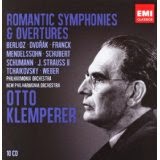
The Klemperer Legacy Part 4: Romantic Symphonies and Overtures; Concertos


EMI 50999 4 04309 2 (10-disc box set) (2012)
Romantic Symphonies and Overtures
(Works by) Berlioz, Dvorak, Franck, Mendelssohn, 
Schubert. Schumann, J. Strauss II, Tchaikovsky, Weber
Otto Klemperer/Philharmonia Orchestra/New Philharmonia

Otto Klemperer understood Romanticism from the inside out. Indeed, few conductors have ever possessed so deeply personal an insight, whether born of intellect or experience, into the stylistic extremes of the period. Plagued for much of his life by what was very probably a form of manic-depressive (bi-polar) disorder, Klemperer's emotional struggles often seem to be mirrored in his music-making; from the triumphal, ecstatic highs, to the anguished, despairing lows. For artists so afflicted, music can be at once refuge and burden, torment and salvation. Yet only the most exceptional, sensitive, and technically gifted find the means to sublimate their sufferings in order to offer the world something truly, transcendently great. Still fewer get to record with a world-class orchestra.

Issued in 2012 as part of a series marking the fortieth anniversary of the conductor's death, this attractive 10-disc box set from EMI certainly has its share of peaks and valleys. Klemperer leads magnificent, near-definitive performances of Schubert, Schumann, Mendelssohn, and Franck, along with respectable essays of Berlioz, Dvorak, Tchaikovsky, Weber and Johann Strauss Jr. The Schubert Symphony #9 is among the greatest of all "Great C Majors" ever recorded; the conductor's characteristically deliberate pacing combined with his long, elegant legato phrasing conveys the lyric grandeur of the music as few others before it--certainly since--and the 2000 re-mastering sounds better than ever. The Schumann symphonies 1, 2, and 4 are brilliant, revelatory readings, though, alas, the lax, overly-casual tempi in the outer movements of the "Rhenish" sap the joy from that most essentially joyful and endearing of all Schumann's orchestral conceptions. Klemperer's Mendelssohn is consistently fine, especially in the dark, misty opening bars of the "Scottish" Symphony, and the slow movement of the "Italian". (I do think the laurel still goes to Charles Munch with the Boston Symphony (RCA/Sony) in this repertory.) Perhaps most surprising is Klemperer's fervent, probing rendition of the Franck d minor symphony, a performance that balances keen structural insight with genuine emotion, though it is, admittedly, hardly in the same league with Pierre Monteux's fiery, heart-pounding 1962 performance with the Chicago Symphony on RCA.

Aside from the Schumann Third, and a Berlioz "Symphonie fantastique" that seems to peter out towards the end, there are no real "clinkers" in this collection. The Tchaikovsky and Dvorak are better than run-of-the-mill--if that sounds like damning with faint praise, the fact is, competition in this repertory is precipitous to say the least. The disc of Weber and Schumann overtures and Strauss waltzes is fine, though not especially scintillating. I do wish EMI's transfer engineers had used the material on that disc as filler on others so that it would not have been necessary to break up some of the major works across discs, especially the Franck and Tchaikovsky "Pathetique" symphonies.

Set contents:

DISC 1: Schubert Symphony #8 D 759 in b minor "Unfinished" (February 1963); Symphony #9 in C D 944 "The Great" (recorded November 1960 (Walter Legge original engineer)) (re-mastering from 2000)

DISC 2: Schubert Symphony #5 in B-flat Major D 485 (recorded May 1963); Mendelssohn Hebrides Overture Op. 26 (February 1960); Symphony #3 in a minor Op. 56 "Scottish" (recorded January 1960)

DISC 3: Mendelssohn A Midsummer Night's Dream Incidental Music Op. 61 (Heather Harper, Janet Baker, Philharmonia Chorus) (recorded January-February 1960); Symphony #4 in A major Op. 90 "Italian" (recorded February 1960)

DISC 4-5: Schumann Symphonies
#1 in B-flat Major Op. 38 "Spring" (October 1965)
#2 in C Major Op. 61 (October, 1968)
#3 in E-flat Major Op. 97 "Rhenish" (February 1969)
#4 in d minor Op. 120 (May 1960)
Scenes from Goethe's Faust Overture (recorded February 1969)

DISC 6: Carl Maria von Weber: Overtures to "Der Freischutz", "Euryanthe" and "Oberon" (recorded May and September 1960): Schumann; Genoveva Overture Op. 81 (October, 1968); Manfred Overture Op. 115 (October 1965); Johann Strauss II: "Die Fledermaus" Overture; "Wiener Blut" Waltz Op 354 and "Emperor" Waltz Op. 437 (October 1961)

DISC 7: Berlioz Symphonie Fantastique Op. 14 (April-September, 1963)

DISC 7-8: César Franck: Symphony in d minor (February 1966)

DISC 8: Dvorak Symphony #9 in e minor Op. 95 "From the New World" (October-November 1963)

DISC 9: Tchaikovsky: Symphony #4 in f minor Op. 36 (January-February 1963)

DISC 9-10: Tchaikovsky Symphony #6 in b minor Op. 74 "Pathétique" (October 1961)

DISC 10: Tchaikovsky: Symphony #5 in e minor Op. 64 (January 1963)

Remasterings from the late 1980s to early 2000s are consistently fine to superb. This set is heartily recommended.


EMI 50999 4 04348 2 (6-disc box set) (2013)
Concertos
(Works by) Mozart, Beethoven, Schumann, Liszt, Brahms
Daniel Barenboim/Annie Fischer/David Oistrakh/Yehudi Menuhin
Otto Klemperer/Philharmonia Orchestra/New Philharmonia

I purchased this set mainly to obtain the electrifying 1960 performance of the Brahms Violin Concerto with David Oistrakh. One of Klemperer's pinnacle achievements, this classic reading has been re-issued a number of times over the past several decades (most recently as part of David Oistrakh: The Complete EMI Recordings (EMI 50999 2 14712 2 (2008)). Out-of-print single-disc albums seem to be commanding ever-heftier prices, and EMI's latest budget series offers the recording only in MP3 format. You can call me old-fashioned--I came of age collecting LPs along with the odd cassette back in the `70s, and have built a collection of well over 1,000 classical CD albums since the mid-`80s--but I still prefer physical media. The idea of getting my music from something called a "cloud" simply doesn't inspire a great deal of confidence (not to mention that the cloud is hardly as eco-friendly as some would have us believe).  Nor does it engage the senses or nourish nostalgia--elements as essential to my enjoyment of listening and collecting as my composerly understanding of musical structure, or an often-too-acute sensitivity to the subtleties of intonation and ensemble. The bottom line is this; if you want the Brahms on DISC at a REASONABLE PRICE, this may well be your last chance.

Released in 2013, this attractive box set offers a mixed bag of Klemperer collaborations. The sound quality is consistently excellent throughout, even if the performances themselves run a rather steep gamut from Oistrakh's brilliantly inspired, lyrical and passionate Brahms, to a laughably torpid Beethoven Violin Concerto with an uncharacteristically lackluster Yehudi Menuhin. To be sure, there is a good deal of perfectly fine music-making in between; the Schumann and Liszt Piano Concerti with Annie Fischer are spot on, and the complete Beethoven Piano Concerti recorded in 1967 with a young Daniel Barenboim range from serviceable to very good in the case of the "Emperor" and the Choral Fantasy. (Admittedly, my benchmark for the Beethoven has been Murray Perahia with Bernard Haitink and the Concertgebouw on Sony.)
Klemperer's approach to Mozart seems positively schizophrenic here. The set features delightful, spritely renditions of the four horn concerti with Alan Civil (1960), along with a massive, heavy-handed performance of the K 503 Piano Concerto (#25), again with Barenboim. There seems to be a generational disconnect in this collaboration; the approach, by today's more intimate, chamberistic standards, seems, at best, wildly over the top; at worst, oppressively atavistic. (I've always favored Perahia's self-led performances with the English Chamber Orchestra on CBS/Sony, which strikes me as a perfect balance of scale and style.)


Here's a rundown of set contents:


DISC 1: Mozart; 4 Horn Concertos (Alan Civil) (1960): Liszt; Piano Concerto #1 (Annie Fischer) (recorded in two sessions between 1960 and 1962)


DISC 2: Mozart Piano Concerto #25 in C Major K 503 (Daniel Barenboim/New Philharmonia) (1967): Beethoven Violin Concerto in D Op. 61 (Yehudi Menuhin), (recorded over four days in January, 1966)


DISC 3-4-5: Beethoven Piano Concerti and Choral Fantasy Op 80 (Daniel Barenboim/John Aldis Choir/New Philharmonia) (recorded in October and November, 1967)


DISC 6: Schumann Piano Concerto in a minor Op. 54 (Annie Fischer; New Philharmonia) (recorded between May, 1960 and August, 1962): Brahms Violin Concerto in D Op. 77 (David Oistrakh; Orchestre National de la Radiodiffusion Française) (recorded in Paris, June 1960))


Long-time collectors will probably decide whether or not to buy the set based on how much of this material they already have. EMI's recent series of economically priced boxes makes it easy to fill in gaps in serious collections while allowing for fresh reappraisal of Klemperer's rich and sometimes-controversial legacy. The present set is recommended for its treasures, if not for its quirks.

The Klemperer Legacy Part 3: Mahler


EMI 50999 4 48398 2 (6-CD box set) (2013)
Mahler: Symhonies 2, 4, 7, 9;
Das Lied von der Erde (Song of the Earth)
Otto Klemperer/Philharmonia Orchestra


EMI (France) 50999 083365 2 (6-CD box set) (2011)
Mahler: Symhonies 2, 4, 7, 9;
Das Lied von der Erde (Song of the Earth)
Otto Klemperer/Philharmonia Orchestra


Would-be Mahler complete-ists will want to add either of these attractive 6-disc box sets of Klemperer's 60s-era recordings to their collection, alongside the recent compilation of Bruno Walter's Mahler readings (Sony 88619201024 (2012)). Together, these sets from the composer's two most prominent younger associates and friends who lived into the age of stereo recording, offer as complete and authentic a picture of Mahler's musical mind as we will ever be likely to obtain short of time travel.

The Klemperer set was initially issued in 2011 by French EMI, and features very-fine recent 24-bit digital remasterings with overall excellent sonics. The 1961 reading of the 4th Symphony with Elisabeth Schwarzkopf and the Philharmonia Orchestra still comes across as rather turgid and, in places, poorly defined, but elsewhere, the sound quality is greatly improved, revealing detail and color often missed in earlier transfers.

Klemperer first met Mahler in 1907, when the young conductor led the off-stage brass in a performance of the Resurrection Symphony (#2), the work which opens this set. A superb performance it is, too, recorded between November 1961 and March 1962 with the Philharmonia Orchestra and chorus, and soloists Elisabeth Schwarzkopf (soprano), and alto, Hilde Rössl-Majdan. The pacing is excellent, the dramatic impact undeniable. It is interesting to compare this performance with Walter's 1958 Columbia Symphony outing; the conductors' two very different personalities are revealed in subtle variations of detail and emphasis, and in the end, who takes the laurel may come down to the chorus and soloists one prefers.
Klemperer's reading of the 9th Symphony is one of the very greatest; again, equaled only by Walter's 1961 performance with the Columbia Symphony, though Klemperer benefits from EMI's superior sound quality. The tempi are typically deliberate, revealing rich detail in the score without loss of momentum or coherency. The slow valedictory outer movements have never been so beautiful or poignant.


But the heart of this set is the 7th Symphony ("Nachtlied" (Song of the Night)). This performance, from September 1968, shows Klemperer at his most uncompromisingly determined and stubbornly controversial. Certainly, few others have ever plumbed the emotional depths of this music with such insight and empathy. The long funeral march of the first movement is utterly shattering in its kinetic force, all the more so because of Klemperer's theatrically lugubrious pacing. Yet, the finale, clocking in at a sprawling 24:15 briefly calls this approach into question. Markedly more deliberate than any other performance of the work, Klemperer is a full eight minutes slower than Solti's brisk 1971 performance for Decca, and nearly six to seven minutes longer than James Levine (RCA, 1982) or Claudio Abbado (DG, 2002). At times, one fears the music may collapse under its own weight, the structure disintegrate altogether, or simply peter out. And yet, somehow, miraculously, Klemperer pulls it off; his 7th an enduring profile in artistic courage.


Rounding out the set is a magnificent performance of Das Lied von der Erde (Song of the Earth); perhaps one of the finest ever recorded, notwithstanding fierce competition from a dozen or more top-tier versions. Where many renditions of the piece feature one outstanding soloist paired with another less inspired artist (Walter's two well-known readings come immediately to mind), Klemperer had the good fortune to work with a duo of equally brilliant singers, both at the height of their powers, a young Christa Ludwig near the beginning of her career, and the inimitable Fritz Wunderlich shortly before his untimely death. The piece was recorded in two sessions in February and November 1964. The sound is impeccable, sparkling and richly textured, capturing every colorful nuance of the score. Vocal characterizations are nigh on to sublime, and, for once, everything is equally memorable, from the virile horn calls of the opening bars to the deep sighs of "ewig, ewig" ("forever, forever") in a fading autumnal halo of strings that brings the piece at last to rest, and all the glorious humor, passion and elation in between.


Filler on the set includes Ludwig's admirable performances of three songs from Des Knaben Wunderhorn and three of the five Rückert Lieder, recorded during the same 1964 sessions as Das Lied von der Erde, and included in the original LP box-set issue of DLvdE from the following year. Interestingly, EMI chose to record a more extensive album of the Wunderhorn songs in 1966, not with Ludwig, but with Elisabeth Schwarzkopf and Dietrich Fischer-Dieskau under Geroge Szell--a fine recording in its own right to be sure. Yet, Ludwig's interpretations are so wonderfully tantalizing as to leave us wishing for more. Her lovely voice and youthful passion simply make Schwarzkopf seem tired by comparison, and, quite frankly, past her prime.


Klemperer's Mahler is historically significant and artistically compelling. This set is highly recommended.


The Klemperer Legacy Part 2: Brahms and Bruckner


EMI 50999 4 04338 2 (4-disc box set) (2013)
Brahms: Symphonies and Overtures;
Ein Deutsches Requiem
Otto Klemperer/Philharmonia Orchestra


Collectors who already have Klemperer's iconic 1961 reading of A German Requiem on disc may be pardoned for taking a pass on this recent box set. Yes, the price is virtually irresistible, and you do get the fine mid-1950s-era performances of the symphonies, the excellent Tragic Overture from 1957, and a very nice 1962 recording of the Alto Rhapsody with Christa Ludwig. It's easy, however, to get most of this material separately, and what's left hardly represents Klemperer at his best, nor are the rather tired-sounding transfers particularly impressive. (In all fairness, I should add that my benchmarks for this repertory have always been the classic 1960 performances of Bruno Walter (Sony) and Bernard Haitink's '70s-era readings for Philips, now available on Decca).

Here's a cursory rundown of what's in the box:


Variations on a Theme by Haydn Op. 56a (mono; recorded October 1954) (remastered 1992)
This is simply awful! One of the worst "Haydn Variations" I've ever heard. There are difficulties with intonation; the woodwinds sound harsh and are poorly blended in ensemble. Klemperer's pacing seems oddly indifferent from variation to variation, his approach utterly devoid of pathos or profundity. (To hear a truly great performance, listen either to Walter's 1960 recording with the Columbia Symphony (Sony), Herbert von Karajan with the Berlin Philharmonic (DG) or, best of all, Haitink with the Concertgebouw (1973), currently available in a 7-disc Brahms Collector's Edition box from Decca.)


Symphony #1 in c minor Op. 68 (October 1956 and March 1957) (remastered 1999)
A very fine performance, but EMI's engineers could only do so much with the muddy mid-50s era masters.


Symphony #2 in D Major Op. 73 (October 1956) (1999)
Klemperer virtually puts us to sleep during the first movement, and fails to rouse us in the finale.


Symphony #3 in F Major Op. 90 (March 1957) (1999)
This isn't bad at all apart from poor definition in the sound.


Symphony #4 in e minor Op. 98 (March 1957) (remastered 1999)
An extremely good performance; Klemperer's temperament is very much in sync with the composer's conception of a passionately dynamic "absolute" music.


Academic Festival Overture Op. 80 and Tragic Overture Op. 81 (March 29, 1957) (remastered 1999)
These are very serviceable performances, especially of Op. 81. The remastered sound is quite good.


Alto Rhapsody Op. 53 (Christa Ludwig; Philharmonia Chorus (men)) (March 1962) (remastered 1999)
The men's chorus may have been a bit too closely miced, but the young Christa Ludwig is compelling. The recording reveals Klemperer in his autumnal maturity.


Ein Deutsches Requiem (A German Requiem) Op. 45 (Elisabeth Schwarzkopf (soprano); Dietrich Fischer Dieskau; Philharmonia Chorus; Philharmonia Orchestra) (March, April, May, 1961) (remastered 1997)
Of all Klemperer's definitive recordings, this is probably the greatest; a fortuitous meeting of brilliant musical minds. Fischer-Dieskau is exceptional, and the Philharmonia Chorus matches him admirably. Elisabeth Schwarzkopf, too, is near the top of her form. (She is not a singer I always particularly care for, given a certain harshness in her tone). Klemperer's pacing captures the dramatic sweep and grandeur of Brahms' conception to near perfection. One of the true classics of the stereo age, this transfer, made with the 1997 re-mastering, is not a dramatic improvement over earlier CD issues, but those transfers were already exceptional.


In sum, this set is a decidedly mixed bag; nine performances running the gamut from woeful to wonderful; awe-inspiring to merely awful. Recommended only to die-hard Klemperer aficionados who simply must have everything; otherwise, my advice is to seek out a recent re-issue of the "German Requiem" from 1997 or later, and give this box set a fairly wide berth.


EMI 50999 4 04296 2  (6-disc box set) (2012)
Bruckner: Symphonies 4-9
Otto Klemperer/Philharmonia Orchestra/New Philharmonia

Klemperer's artistic temperament was ideally suited to the interpretation of Bruckner. Well-known in his later career, some might say notorious, for markedly slow tempi, the conductor's approach didn't always work well with every piece, and his failures could be as spectacular as his successes were sublime. Among those less-than stellar efforts, the odd, logy reading of Schumann's "Rhenish" Symphony from 1969, and the singularly awful 1966 recording of the Beethoven Violin Concerto with Yehudi Menuhin come immediately to mind. Brilliant successes include near-definitive renditions of the Brahms Violin Concerto with David Oistrakh (1960) and German Requiem (1961), Schubert's "Great C Major" Symphony (1960), Mahler's 9th Symphony (1967) and Das Lied von der Erde (1964). Klemperer's Bruckner, if not always rarefied, is nonetheless, consistently fine. 

Though massive in scope, often sprawling in their cathedral-like scale, these symphonies aren't particularly complex or structurally convoluted, and this is precisely the kind of musical environment in which Klemperer was able to thrive. Like the most sensitive and committed of tour guides, he gives his listeners time to take in the full grandeur of Bruckner's architecture before moving them along, remarking on details that might otherwise easily be overlooked by a more hurried docent.

Issued in 2012, this attractive box set from EMI offers consistently well-turned performances of six of Bruckner's ten symphonies recorded between 1960 and 1970; #s 4 (1963) and 7 (1960) were recorded with the Philharmonia Orchestra; #5 (1967), #6 (1964), #8 (October-November 1970), and #9 (February 1970) with the New Philharmonia. Remasterings were done between 1990 and 2004, and the quality of the present transfer is excellent. Bruckner aficionados should note that these are the Novak editions, with the exception of Symphony #7, which employs the Haas edition.
Comparisons with the near-contemporaneous recordings by Bruno Walter and the Columbia Symphony may be inevitable. I prefer Klemperer's 4th, especially the near-perfect pacing in the slow second movement. (My benchmark recordings of the "Romantic" Symphony include Herbert von Karajan with the Berlin Philharmonic on DG as well as Daniel Barenboim with the Chicago Symphony on DG, both currently available as part of integral box sets.) Walter and Klemperer's interpretations of the 7th are equally satisfying, but I give the laurel unhesitatingly to Walter, with Karajan a close runner-up, next to whom Klemperer seems rather lightweight where dynamic contrast is concerned. Both Walter and Karajan's long-line are more forcefully coherent, and Columbia's recorded sound in the case of the former is breathtaking--a pinnacle achievement in early stereo recording. EMI's sound, while perfectly adequate, is not particularly memorable.
While it's too bad Walter never found time to record the 6th and 8th symphonies, these two works are among the true treasures of the Klemperer set. And, as much as I admire the superbly energetic and better-sounding recordings of Bernard Haitink (with the Concertgebouw on Philips) and Pierre Boulez (with the Vienna Philharmonic on DG), I absolutely LOVE Klemperer's stately reading of the 8th; the slower tempo of the scherzo lends greater weight to what is already a work of awesome power. There's less competition when it comes to the smaller-scale 6th. This too, is an excellent reading; one might even call it Bruckner at his most intimate, a spirit Klemperer captures most admirably. As to the 5th; I would give the unhesitating nod to Gunter Wand's electrifying reading with the Cologne Radio Symphony (currently available on Sony 99697776582 (2010)), though I have little doubt that those who admire the piece will also think highly of Klemperer's very-serviceable reading.


In the end it's lovely to have these superb performances gathered together under a single cover, and at an attractively modest price, too. Bruckner fans, Klemperer complete-ists, admirers of classic stereo, and lovers of great music should all be delighted.


The Klemperer Legacy Part 1: Beethoven


EMI 50999 4 04275 2 (10-disc box set) (2012)
Beethoven: The Orchestral Recordings:
Symphonies and Overtures
Otto Klemperer/Philharmonia Orchestra/New Philharmonia


An illuminating--if not always electrifying--survey of Otto Klemperer's EMI Beethoven recordings from the 1950s and `60s; this generous 10-disc box set from 2012 has much to offer fans of both the composer and the conductor. The heart of the set is the complete symphonic cycle, recorded in stereo between 1957 and 1960 with the Philharmonia Orchestra in London's Kingsway Hall. Collectors will be pleased to find additional readings of several of the symphonies (no fewer than three versions of the Seventh!) and popular overtures, a few recorded in mono between 1954 and '55; and others from the mid to late 1960s, making for a through-going, intense, and highly rewarding listening experience.

There's nothing polarizing, or especially galvanizing, about Klemperer's Beethoven. For the most part, his interpretations stake out a modestly traditional middle ground, which, while not raising eyebrows or blood pressure, are decidedly less in service to the conductor's ego than the composer's score. Listeners will not find in these readings the bombastic thunderings of a tortured titan. There is no heaven storming here. Klemperer does not attack the music with the technical ferocity of a Toscanini (would that, at times, he did); nor does he attempt the daringly modish as Herbert von Karajan (1962) or Carlos Kleiber (1975-76) (both for DG). To modern ears, Toscanini's Beethoven can at times seem heavy-handed (I've never cared for his overblown reading of the Fourth, and am still fairly lukewarm (after nearly fifty years) regarding his "Eroica", though I think his Fifth and Ninth are the greatest ever recorded), but the long line is always clearly defined, its inevitability never in doubt. Structural coherency is never an issue, even if texture and dynamics sometimes are. By contrast, Karajan can be too light; his radical, ultra-frenetic readings can come off as flippant, even soulless, in their too-buoyant alacrity. At his best, Klemperer lands somewhere well between these two interpretive poles.

The true crown jewels of this collection are the shorter works, the well-known overtures and incidental pieces, particularly on disc 9. Klemperer's July 1956 recording of "The Consecration of the House" is one of the most hair-raisingly brilliant things he ever did, and by itself, nearly worth the price of the set--though, alas, the later 1959 recording included on the same disc barely inspires a half-hearted stage yawn. There are superb readings of the various "Leonore" and "Fidelio" overtures, again, in several different recorded versions, as well as very fine renditions of the "Egmont" incidental and "Creatures of Prometheus" ballet music.

The symphonies represent a decidedly mixed interpretive bag. The Kingsway Hall cycle, with the glaring exception of the Ninth, is generally quite good (First, Third, Fourth, Fifth), if sometimes merely fair (Second, Sixth, Seventh, Eighth). Some listeners may remark a certain heaviness in the orchestral texture, which can (as in the case of the Eighth) pull things down rather awkwardly. Klemperer's predilection for more deliberate tempi does not always work in his favor; the conductor recorded the Seventh on no fewer than three occasions, but somehow never managed to set the music ablaze. On the other hand, his relatively slow-paced 1959 "Eroica" is a justly lauded classic, and the mono 1955 recording is nearly as fine.

The nadir of this set is an "unfortunate" reading of the Choral Symphony recorded between October and November, 1957. The Ninth is one of those works in which vast, disparate elements must come together just so; myriad musical egos set aside their differences for the sake of a miraculous momentary synergy; I do not know of a more perfect piece of music that has so defied a perfect performance. A few have come close; Toscanini (RCA); Böhm (DG); John Eliot Gardiner (Philips); even the recent reading by Vanska (BIS); but it's doubtful the score has ever been realized to its fullest potential; I honestly don't think it's possible. This is in no way to excuse Klemperer's ill-advised essay that impresses more as an example of a petulant conductor versus a defiant orchestra than a meeting of great musical minds. Ensemble is ragged; entrances are sloppy; whole instrumental sections are lost in a miasmic blur of confused sound. The plodding scherzo never achieves critical velocity; like some Sisyphusian figure attempting to run up the side of a hill, but never building enough momentum to crest the top. In the finale, the introduction is treated without reverence, a thing to be gotten past. The solo vocal ensemble is simply horrid; the chorus and orchestra out of sync much of the time. This performance is little short of a disaster that should never have seen the light of day.


[The assertion by some breathless "Klemperer groupies" that this performance of the Ninth couldn't possibly be so bad as all that, based on the assumption that "arch-perfectionist Walter Legge" would never have allowed it to be released, is not only an example of seriously flawed logic (so and so likes this so it must be good), but represents a simplistic understanding of the very complex and thorny relationship between the conductor and the executive. In fact, Legge was happy to tolerate Klemperer's tyranical tendencies, his sometimes bizarre mood swings and divers eccentricities so long as the conductor's name was selling records for EMI, the "bottom line" being his principle driving concern. Nor was Legge about to lay out money in order to record a large (and I presume expensive) piece like the Ninth without seeing a return on his investment--the man had a cultivated reputation as an artistic perfectionist, but he was a businessman first and foremost. The two men ultimately had a falling out, both refusing either to speak to the other, which may have been due to Legge's simply getting fed up, or the fact that Klemperer--in spite of the drawing power of his name and many superb, even sublime readings--did occasionally turn in sub-par performances--this Ninth, the 1954 Brahms' Haydn Variations (with out-of-tune winds no less!), the 1966 Beethoven Violin Concerto with Yehudi Menuhim which is as turgid and lifeless a reading as one could imagine, and a notorious handful of others--all of which the great Mr. Legge and his successors at EMI had no qualms about releasing. So, if Legge was such an "arch-perfectionist" how did these demonstrably less-than-perfect recordings get past him? Ka-ching! Ka-ching! That's how! Some die-hard fans simply cannot accept the fact that their "god" was sometimes prone to fallibility, or that their hero was, on occasion, a clay-footed klutz.]


It goes without saying that most, if not all, this material has been available separately for many years. The Kingsway stereo cycle made its first appearance on CD in the mid-1980s and has been re-issued several times since. Most of the re-masterings for this present box set date from the late 1990s and early 2000s, representing a marked improvement over earlier issues.

Here's a summary of the contents. I've included the month and year each work was recorded as noted in the liner notes, along with the year in which the session was re-mastered. This does make a difference, as the technology for mastering and transferring pre-digital recordings has advanced significantly over the past three decades. Transfer engineers in the early `80s often failed to recognize the broader dynamic potential of the new digital technology, or take informed advantage of the full aural pallet, with the result that some of the earlier re-masterings retain a rather timid, tired-sounding quality.


DISC 1

Symphony #1 in C Op. 21 (October 1957) (1998)
Symphony #6 in F Op. 68 "Pastorale" (October, 1957) (2003)

DISC 2

Symphony #2 in D Op. 36 (October, 1957) (1998)
Symphony #5 in c minor Op. 67 (October, 1959) (1998)

DISC 3

Symphony #3 in E-flat Op. 55 "Eroica" (November, 1959) (1998)
Große Fugue Op. 133 (March, 1956) (1998)

DISC 4

Symphony #4 in B-flat Op. 60 (October, 1957) (1990)
Symphony #7 in A Op. 92 (October-November-December, 1960) (1990)

DISC 5


Symphony #8 in F Op. 93 (October, 1957) (1998)
Leonore Overture #1 Op. 138 (November, 1963) (1998)
Leonore Overture #2 Op, 72a (November, 1963)
Leonore Overture #3 Op. 72b (November, 1963)

DISC 6

Symphony #9 in d minor Op. 125 "Choral" (October-November, 1957) (1998)
Aase Nordmo Lovberg (sop); Christa Ludwig (alt); Waldemarr Kmentt (tenor); Hans Hotter (bass)

DISC 7

Symphony #3 "Eroica" (MONO: October-November, 1955) (2002)
Leonore Overtures #s 1 and 2 (MONO: November 1954) (2002)

DISC 8

Symphony #5 (MONO: October-December, 1955) (2002)
Symphony #7 (October, 1955) (1987/2002)

DISC 9

Leonore Overture #3 (MONO: November, 1954) (2012)
Fidelio Op. 72 Overture (MONO: November, 1954) (2012)
Die Weihe des Hauses (The Consecration of the House) Op. 124 (July, 1956) (2012)
Die Geschöpfe des Prometheus (The Creatures of Prometheus) Op. 43 Overture (November, 1957) (2003)
Egmont Incidental Music Op. 84 (October-November, 1957) (2003)
Birgit Nilsson (soprano)
König Stephan (King Stephan) Op. 117 Overture (October, 1959) (2000)
Consecration of the House (October, 1959) (2000)

DISC 10

Fidelio Overture (February 1962) (2000)
Symphony #7 (1968) (2012)
The Creatures of Prometheus Ballet Op. 43 (October, 1969) (1977 & 2012)

Recommended.

Monday, February 16, 2015

Schumann the Arch-Romantic


Deutsche Gramaphon (Archiv Produktion) 479 2515 (5-CD box set) (2014)
Schumann: Complete Symphonies
Das Paradies und die Peri Op. 50 etc.
The Monteverdi Choir
Orchestre Révolutionaire et Romantique
John Eliot Gardiner


If you missed any of these scintillating, uniquely passionate performances when they first appeared in the mid-1990s, you owe it to yourself to get a copy of this attractive 5-disc compilation from Deutsche Gramophone's Collector's Edition line of re-issues. As with other entries in the series, this handsomely laminated box includes discs in sufficiently sturdy cardboard slipcases along with a semi-glossy booklet of documentation, all firmly--yet not too tightly--packaged. The set includes the four symphonies, as well as a second version of the Fourth, and an earlier unfinished Symphony in g minor; the exciting Konzertstuck (Concert Piece) for 4 horns and orchestra Op. 86, and the Overture, Scherzo, and Finale Op. 52; a pair of choral works, the rarely-heard Requiem for Manon Op. 98b, and Nachtlied for chorus and orchestra Op. 108. Perhaps the true highlight, and certainly the great "find" on this set is the thoroughly delightful, sparklingly lyrical 1843 oratorio Das Paradies und die Peri (Op. 50), featuring the magnificent Barbara Bonny as the Peri.

Gardiner's Schumann is nothing short of revelatory; not necessarily because of its unique period-instruments sound, but more, I think, because this is a conductor who is less concerned about proving Schumann's status as a "great" or "serious" composer, than deeply committed to revealing him as the unabashed, exciting, full-blown first-among-romantics he surely was. The supposedly-familiar symphonies have never been so thrilling, dynamic, hard-driving, and viscerally compelling. This is Schumann with some real blood pumping in its veins! Perhaps, more raucous and even a bit rude when compared to so many of the elegant "mainstream classical" interpretations familiar to most, Gardiner's readings have much less Mendelssohn-ian elegance and a good deal more Beethoven-ian fire about them. As always, the Orchestre Révolutionnaire et Romantique plays with grandeur and panache, and though the period-instruments sound can at times be somewhat obtrusive--especially in the brassy tutti sections--the emotive impact of the music is undeniable.

Enthusiastically recommended!

Thursday, February 5, 2015

In Search of Brahms' "Complete" Choral Works


Deutsche Gramaphon 479 4020 (7-CD box set) (2015 compilation)
Brahms: Complete Choral Music:
Ein Deutsches Requiem (A German Requiem) Op 45.
Barbara Bonney/Andreas Schmidt
Carlo Maria Giulini/Vienna Philharmonic et al.
Rinaldo Op. 50 (Rene Kollo)
Alto Rhapsody Op. 53 (Brigitte Fassbender)
Schicksalslied (Songs of Destiny) Op. 54
Triumphlied (Song of Triumph) Op. 55 
Nänie Op. 82 
Gesang der Parzen (Song of the Fates) Op. 89
Giuseppe Sinopoli/Prague PO Chorus/Czech Philharmonic
Complete Works for a cappella chorus:
13 Kanons (Canons) Op. 11; Ave Maria Op. 12; Begräbnesgesang (Funeral Song) Op. 13;
4 Gesänge Op. 17: Marienlieder (Songs of Virgin Mary) Op. 22; Psalm 13 Op. 27; 
Motets Op. 29, 74, 110; Geistliches Lied (Spiritual Song) Op. 30;
3 Geistliches Chöre (Sacred Choruses) Op. 37; 5 Lieder Op. 41;
Gesänge Op. 42 & 62; 12 Lieder und Romanzen (Songs and Romances) Op. 44;
7 Lieder und Romanzen Op. 93a; Tafellied (Table Song) Op. 93b; 
5 Lieder Op. 104;  Fest und Gedenksprüche (Celebration and Thanksgiving) Op. 109;
Kleine Hochzeits Kantate (A Little Wedding Cantata) WoO 16;
Dem Dunkeln Schoß  (The Dark Womb of Sacred Earth) WoO 20;
7 Kanons (Canons) WoO 24-30;
Deutsches Volkslieder (German Folk Songs) WoO 34 & 35
Gunther Jena/NDR (North-German Radio) Choir


Brilliant Classics 92179 (8-CD box set) (2003)
Brahms: Choral Works
Nicol Matt/Chamber Choir of Europe


Brilliant Classics 94262  (6-disc set with CD-ROM) (2011 re-issue)
Choral Classics: Brahms Choral Works
13 Kanons (Canons) Op. 11; Ave Maria Op. 12;  4 Gesänge Op. 17: 
Marienlieder (Songs of St. Mary) Op. 22; Psalm 13 Op. 27; 
Motets Op. 29, 74, 110; Geistliches Lied (Spiritual Song) Op. 30;
Vocal Quartets Op. 31, 64, 92 & 112a; 
3 Geistliches Chöre (Sacred Choruses) Op. 37; 5 Lieder Op. 41;
Gesänge Op. 42 & 62; 12 Lieder und Romanzen (Songs and Romances) Op. 44;
Liebesliederwalzer (Love Song Waltzes) Op. 52; 
Neues Liebesliederwalzer (New Love Song Waltzes) Op. 65;
7 Lieder und Romanzen Op. 93a; Tafellied (Table Song) Op. 93b; 
Zigeunerlieder (Gypsy Songs) Op. 103 & 112b;
5 Lieder Op. 104;  Fest und Gedenksprüche (Celebration and Thanksgiving) Op. 109
Kleine Hochzeits Kantate (A Little Wedding Cantata) WoO 16
Missa Canonica WoO 18;
Dem Dunkeln Schoß  (The Dark Womb of Sacred Earth) WoO 20
7 Kanons (Canons) WoO 24-30;
7 Volkslieder (Folk Songs) WoO 33;
Deutsches Volkslieder (German Folk Songs) WoO 34 & 35
Nicol Matt/Chamber Choir of Europe


Not to split musicological hairs, but this recent box set from Deutsche Gramophone's Collector's Edition series does not, in fact, contain the "complete" choral works of Brahms. Even if one were not to allow that those pieces originally conceived for vocal quartet should be counted alongside those composed with a choir or large chorus in mind, this collection omits the Missa Canonica WoO 18, as well as the 7 Volkslieder (Folk Songs) WoO 33. (I do, personally, count the vocal quartets as legitimately belonging to Brahms' overall choral ouevre when they are presented by larger groups, as they can be particularly effective when "fleshed out".) I suppose this set's omissions aren't really such a big deal--and certainly, not an issue worthy of a hissy fit-- but, on the other hand, classical complete-ists really do expect completeness when a collection is advertised as such.

Happily, the set does include fine performances of all the works for chorus and orchestra, as well as most (not all) of the works for a cappella choir or chorus with non-orchestral accompaniment. Gunther Jena's survey of this latter repertory was originally released on digital LP in 1983 as part of Deutsche Gramophone's lavish Brahms edition, marking the 150th anniversary of the composer's birth. (DG 2741 018). The vocal quartets, performed as such, were released on a separate volume in the series. The Jena set has been re-issued on CD several times, including a 4-disc package from 1996, and, most recently, as part of DG's  massive 46-disc Complete Works of Brahms box (DG 001302602 (2009)).

Jena's interpretations are uniformly serviceable, if seldom among the very greatest; his tempi agreeably logical, his sound ideal, to my ears, a bit dense and occasionally overblown. The recordings seem to have originated in multiple sessions made in disparate venues over the course of several years, and the contrast from track to track  can be quite jarring, especially where the occasional soloist is miced too closely at the expense of the chorus, thus skewing the listener's aural perspective. On the very positive side, Jena's pacing of the charming Marienlieder Op. 22 is as good as it gets; his reading of the blithe and bubbly Taffelied (Table (or Toasting) Song) a frothy treat, and the set includes a very fine rendition of the magnificent Begräbnesgesang (Funeral Song) Op. 13 with its unusual wind-band accompaniment. In the final analysis, there's nothing technically "wrong" with any of these performances, and a casual collector looking for this repertory in a convenient, relatively inexpensive format will not be disappointed.

And yet, there are decidedly superior performances, better focused and more consistently well recorded, all easily available at present, which I would certainly recommend ahead of the DG set. Topping that list are the absorbing, unfailingly gorgeous, consistently wonderful readings by Nicol Matt and the Chamber Choir of Europe for Brilliant Classics, originally issued in an 8-disc box set from 2003 (92179), currently available on an even better-sounding (and bargain-priced to boot!)  6-disc album from 2011 (94262). Matt's survey takes in the works for vocal quartet, including both sets of Liebeslieder Waltzes (Op. 52 and 65), and the Zigeunerlieder (Gypsy Songs) Op. 103 & 112b. It includes the WoO 33 folk song settings, and three movements from the Missa Canonica WoO 18, with its soaring themes borrowed from the sacred motet Op. 74 #1; the posthumously published work has been known to musicologists since 1903, so it's hard to understand why Jena and DG would have overlooked it eight decades later. Still, ultimately, Matt doesn't get any closer to "complete" than Jena, as the Brilliant Classics set excludes the Begräbnesgesang, as well as the organ-accompanied Kyrie movement from the Missa (which can be found on Marcus Creed's lovely disc of Brahms' sacred choral works with the RIAS Chamber Choir (Harmonia Mundi HMG 501591 (2009)). 

Matt's choral sound ideal is consistently lucid and transparent, and this is nowhere more evident or impressive than in the seven sacred motets (two each from Opus 29 and 74, and the three that comprise Opus 110). The conductor seems to have instructed each section to produce its own very discrete vocal color, which, in effect, allows individual lines to stand out subtly within the ensemble, regardless of how "busy" or densely textured the whole. The composer's exquisite contrapuntal textures are, thus, never muddied; no single part allowed to overpower another. These interpretations approach the finest available, though for what is probably the best single-disc survey of Brahms' sacred choral works, I would wholeheartedly recommend Martin Best with the Corydon Singers (Helios  CDH 55346 (2010 re-issue of Hyperion CDA 66389 (1991)), stirring, technically impressive performances, ravishingly recorded.

Thankfully, both Jena and Matt do see fit to include Brahms' sublime if all-too-brief  setting of Schiller's Dem Dunkeln Schoß  (The Dark Womb of Sacred Earth) from the great poet's epic Song of the Bell, one of the most beautiful choral pieces ever composed. (I place it, lovingly, alongside the vocal quartet Op. 92 #1, O Schöne Nacht (O Lovely Night) (found on the Matt set), as one of those pieces I would take with me to that proverbial desert isle, or, at least, insist on having performed at my funeral.) Both conductors acquit themselves admirably in the shorter, lighter pieces.

As to the works for chorus and orchestra: Carlo Maria Giulini's live 1987 reading of  Ein Deutsches Requiem Op 45 with the Vienna Philharmonic and Singverein is among the finest recordings of the piece made in recent decades, benefiting greatly from a marvelous pair of soloists. Barbara Bonney's ravishing soprano elucidates the composer's glorious lyric lines with seeming effortless grace, while Andreas Schmidt brings a lyric sensitivity to the more extensive baritone part, with more than ample dramatic weight. Unsurprisingly, Giulini's reading has been re-issued on a fairly regular basis over the intervening thirty years, perhaps most familiarly as part of the DG Masters Series (445 546 (1995)), as well as the 2009 Complete Works box set.

Giuseppe Sinopoli's survey of the remaining orchestra-accompanied works was recorded in Prague in 1982, a joint production of Deutsche Gramophone and the Czech Supraphon label. Again, as with Jena's readings of the a cappella works, these are good, note-perfect performances, well recorded. On first hearing I found  Sinopoli's approach rather dry more often than not, and even a bit earthbound notwithstanding their technical impressiveness. Subsequent hearings have done much to convince me, however. Sinopoli's Rinaldo is probably the best on record, and the Alto Rhapsody Op. 50 with Brigitte Fassbender is very fine indeed, notwithstanding stiff historical competition from the likes of  Christa Ludwig and Dame Janet Baker; the music here seemingly sculpted with masterly dramatic understatement and near-perfect pacing. The set also includes satisfying, richly-detailed performances of the Schicksalslied (Songs of Destiny) Op. 54 with its echoes of Ein Deutsches Requiem, the sublime Nänie Op. 82, and the autumnal masterpiece  Gesang der Parzen (Song of the Fates) Op. 89.

I'd also add a quick word about two of the less-familiar works in this set:

Rinaldo Op. 50 
Brahms' dramatic cantata, based on Goethe's free reinterpretation of Tasso, was begun in 1863 when the composer was thirty, but not completed till several years later, and was thus published with a deceptively high opus number. The music clearly shows the youthful influence of Schumann, and, in fact, had the older composer written this, it would probably be hailed as a minor masterpiece alongside Faust and Das Paradies und die Peri. As a fairly early, stylistically atypical work of Brahms, however, it is sometimes regarded as little more than a footnote, a singular curiosity. A few too many misguided, overblown interpretations of the work haven't done much for its fortunes, either. Most notably in recent times, Claudio Abbado with the heroic tenor James King, seemed to regard the music as Brahms' attempt to channel Wagner--that performance was most recently available on a 2-disc compilation from Decca (452-582-2 (1997)) Fortunately, Sinopoli with soloist Rene Kollo "get" what Abbado and King didn't, turning in a convincingly lyrical, pleasingly fleet-footed performance that makes the best possible case for the work.

Triumphlied (Song of Triumph) Op. 55 
Not atypical as a piece of mid-nineteenth-century "occasional music", but quite unique when considered within the context of Brahms' total oeuvre, the Opus 55 Triumphlied is very much cut from the same flashy cloth as better-known "grand gestures" of the period like the Bruckner Te Deum and Psalm 150, or Mendelssohn's choral Psalms, all composed for big public occasions. An appropriately celebratory text from the book of Revelations is set straightforwardly, without a great deal of contrapuntal subtlety, while the "flashy" brass-heavy orchestral part is an uncanny foreshadowing of the composer's Opus 80 Academic Festival Overture. I don't think it would be at all unfair to call this work a curiosity, albeit a fairly diverting one.

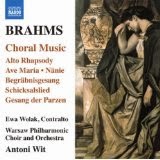
In sum, though mindful of the caveats noted above, I can recommend the DG set, especially for the fine performances of the large-scale pieces. Those in search of a good single-disc survey of the orchestra-accompanied works may wish to explore Naxos 8.572694 (2012). This disc represents an extraordinary bargain, as it  includes superb performances of the Alto Rhapsody Op. 53 (soloist Ewa Wolak), Schicksalslied (Songs of Destiny) Op. 54, Nänie Op. 82, and Gesang der Parzen Op. 89. Conductor Antoni Witt also leads his fine Warsaw Philharmonic Choir and Orchestra in excellent readings of the Opus 12 Ave Maria, and Opus 13 Begräbnesgesang. 

The two sets of Liebeslieder Waltzes and other works originally composed for vocal quartet have fared quite impressively on record in the digital era. John Eliot Gardiner's 1992 outing for Philips (currently available as a Philips Originals re-issue (666-902-2 (2006)) is rightly admired, but I would enthusiastically commend Robert Shaw's 1993 performances instead (Telarc CD-80236). The Telarc disc includes both the Opus 52 and 65 sets in addition to breathtakingly gorgeous essays of some of the composer's most beautiful "night songs". As good as Gardiner may be in this repertory, Shaw is nothing short of sublime.


SELECTED DISCOGRAPHY


Harmonia Mundi HMC 901122 (1983)
Brahms: Motets Op. 29, 74, & 110
Fest und Gedenksprüche Op. 109
Philippe Hereweghe/La Chappelle Royale/Ghent Collegium Vocale


RCA RCD1 4916 (1984)
Brahms Songs and Romances
Ave Maria Op. 12
4 Lieder Op. 17: 6 Lieder Op. 93a
Taffellied Op. 93b
Lieder und Romanzen Op. 44
Richard Westenburg/Musica Sacra


Hyperion CDA 66389 (1991)
Helios  CDH 55346 (2010 re-issue)
Musical Heritage Society MHS 514509A (1997 re-issue)
Brahms: Motets Op. 29, 74, & 110
Geistliches Lied Op. 30: Ave Maria Op. 12
3 Geistliches Chöre (Sacred Choruses) Op. 37
Psalm 13 Op. 27: Fest und Gedenksprüche Op. 109
Matthew Best/Corydon Singers et al.


Philips (The Originals) 666-902-2 (2006 re-issue from 1992)
Brahms Choral Works
Liebeslieder Waltzes Op. 52
4 Lieder Op. 17
Lieder Op. 42 & 102
Quartets Op. 92
John Eliot Gardiner/The Monteverdi Choir


Telarc CD-80236 (1993)
Brahms: Liebeslieder Waltzes--Evening Songs
Liebeslieder Waltzes Op. 52
Neues Liebeslieder Waltzes Op. 65
selections from Op. 42, 62, 64, 92, 103, 112
Robert Shaw/Robert Shaw Festival Singers


Decca (Double Decker) 452-582-2 (2-CD set) (1997 compilation)
Brahms: Choral Works
Begräbnesgesang  Op. 13
Alto Rhapsody Op. 53 (Jard van Ness)
Schicksalslied (Songs of Destiny) Op. 54
Nänie Op. 82 
Gesang der Parzen Op. 89
Herbert Blomstedt/San Francisco Symphony and Chorus
Rinaldo Op. 50 (James King)
Claudio Abbado/Ambrosian Chorus/New Philharmonia
Motets Op. 29, 74, & 110
Geistliches Lied Op. 30
Simon Preston/New English Singers


Chandos CHAN 9671 (1999)
Brahms A Cappella
Marienlieder Op. 22: 
Motets Op. 29. 74 & 110
Fest und Gedenksprüche Op. 109
Stefan Parkman/Danish National Radio Choir


Chandos CHAN 9806 (2000)
Brahms Choral Works
Op. 17, 42, 103, 104, 112
Stefan Parkman/Danish National Radio Choir


Harmonia Mundi HMG 501591 (2009)
Brahms Geistliche Chormusik (Sacred Choral Music)
Motets Op. 29, 74, & 110
Fest und Gedenksprüche Op. 109
Missa Canonica WoO 18
Marcus Creed/RIAS Chamber Choir


Harmonia Mundi HMG 501592 (2-CD set) (2010)
Brahms: Secular Choral Songs
Songs Op. 17, 42, 62, 104
Quartets Op. 31, 64. 92, 112a
Zigeunerlieder Op. 103 & Op. 112b
Marcus Creed/RIAS Chamber Choir


Naxos 8.572694 (2012)
Brahms Choral Music
Ave Maria Op. 12
Begräbnesgesang  Op. 13
Alto Rhapsody Op. 53 (Ewa Wolak)
Schicksalslied (Songs of Destiny) Op. 54
Nänie Op. 82 
Gesang der Parzen Op. 89
Antoni Wit/Warsaw Philharmonic Choir and Orchestra